Is Anyone Using The Apogee One For Mac Yet 2018
The Apogee One is a brilliant bit of kit, with a high quality condenser mic built in, with the means to record live guitars and other outboard equipment that involves a jack lead. I am a producer, and I work with a few singers. The apogee One enables me to plug it into my Macbook where ever I. May 23, 2014 With an intuitive controller knob and seamless compatibility with Mac OS X, ONE is easy for anyone to use and works great with GarageBand, Logic Pro X, Pro Tools, Ableton or any Core Audio compatible application. When you buy and register your Apogee ONE, you have exclusive access to the best prices on Waves audio plugins. The new Apogee ONE is an all-in-one portable, USB audio interface that gives you everything you need to make professional recordings on the go. You can connect a microphone, guitar or use ONE’s exceptional built-in omnidirectional microphone to easily capture your music without compromise. One issue to think about is cable support. I intended to try Duet for using my iPad as an second monitor for both a Mac and a PC. But my new iPad Pro 2018 only takes USB-C input, and my Mac & PC are both USB-A. According to the Duet folks, there is not yet an Apple-certified USB-A to USB-C cable.
- Is Anyone Using The Apogee One For Mac Yet 2018 Full
- Is Anyone Using The Apogee One For Mac Yet 2018 Date
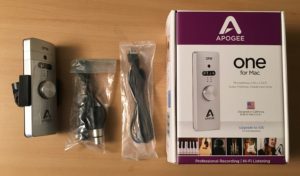
It's tiny, shiny and everything you'd expect from an Apogee interface.
The Apogee One is a little brother to the two‑channel Duet and comprises a single‑channel audio interface in a very compact and stylish enclosure. The One is USB powered and features a mono input, stereo output and built‑in microphone, as well as a prominent multi‑function continuous encoder knob. Apogee's reputation for sound quality is near legendary, and the One offers 24‑bit audio at sample rates of up to 48kHz and a mic preamp with 48V phantom power.
Installation & Impressions
The supplied driver DVD requires Mac OS 10.5.7 or higher and only about 34MB of space. Installation is very straightforward and is completed by a reboot.
One minor issue for me at this point was the length of the supplied USB cable. I know that a lot of potential One users will have laptop systems, but my Mac is located under my desk and the cable wasn't long enough for me to have the One anywhere near to where I would ideally have wanted it. Not a major problem, but still frustrating.
Once I had connected the One, I launched the bundled Maestro software and was presented with the Maestro Control and Maestro Mixer pages. Given that the unit is a mono‑input, stereo‑output device these are, understandably, very simple. The Mixer displays a meter, fader and mute/solo buttons for the single input and 'From Software' channels, with a slightly larger meter displaying the overall 'To Hardware' output level. Maestro Control, on the other hand, has gain controls for both the input and output levels, and the input is selectable between Internal Mic, External Mic, External 48V Mic and Inst(rument).
Turning to the inputs and outputs themselves, the internal microphone and instrument inputs offer 45dB of gain, while the external microphone has a gain range of 10 to 63dB, which is quite healthy. In addition, there is a switchable 48V phantom power option, although I wonder how much additional drain this would involve if your laptop was running on battery power.
An XLR and a quarter‑inch jack input are provided via a supplied breakout cable, which does much to reduce the size of the One (the unit measures just 120 x 60 x 25mm) and is an increasingly common solution for small units like this. The cable is not overly long and has a locking connector, so it shouldn't get detached in the middle of that perfect take. The output (to speakers or headphones) is via a 3.5mm stereo mini‑jack connector located at the bottom of the unit. While this does make some sense for headphones, it feels a little unwieldy and I would have preferred it to be located on the top of the unit along with all of the other connectors. There is certainly room on the casing for it, and it would just have made more ergonomic sense for a speaker output. Perhaps Apogee could even have duplicated the output sockets, with the provision that if the speaker output was connected it would bypass the headphone output?
The big silver knob on the front of the One is used to control the level of either the currently selected input or the output. Pressing the knob briefly will cycle through the various input and output options, to allow you to change gain settings. A display (very similar to the built‑in Mac OS volume display) appears on your screen when you're making changes and shows which input or output is being adjusted. If the knob is pressed and held for one second, the output it muted, which is certainly a useful feature.
Finally, there is an LED indicator for the phantom power (the red LED directly above the external mic indicator) and a three‑segment LED that shows the level for the selected input or output.
In Use
The first thing to consider is that the One, unlike the Duet, will only operate at sample rates of up to 48kHz. Whether or not this is a deal breaker really does depend on your setup and preferred way of working, but for many this may not be an issue. Also, given that the One seems to be largely targeted at mobile/laptop production rigs, the limited sample rates might not be so much of a problem, as the more limited processing power available in these kinds of system may well preclude working at higher sample rates anyway. As mentioned above, there is really very little to do in setting up the One to work as a straightforward 'soundcard'. There is, however, the option of low‑latency live monitoring, which is set up through the Maestro Control Panel. This works well for times when software monitoring latency is a problem, and is extremely easy to set up.
Sockets for the USB connection and breakout cable. The 3.5mm stereo output is at the other end.
RotWK Patch 2.01 Download Patch 2.02 is based off of the official 2.01 patch, so if you want to play 2.02, you'll need to install 2.01. We highly recommend obtaining the patch from the game itself, by selecting 'Check for Updates' from your Windows Start Menu. Browse RotWK Patch 2.02 mod for Battle for Middle-earth II: Rise of the Witch King files to download full releases, installer, sdk, patches, mods, demos, and media. Apply the official LotR: Battle for Middle-Earth 2 - Witch-King v2.01 Patch. Replace the original GAME.DAT file with the one from the File Archive. Play the Game! This is the retail patch 2.01 for the English release of Battle for Middle-Earth II: Rise of the Witch-King. A patch updating the English edition of LOTR: The Battle for Middle Earth II: Rise of the Witch King to v2.01. Along with the release of this quarter's iteration of 2.02, we present to you the long-anticipated Rise of the Witch-king 2.02 League, a ranking system platform which is installed along with patch version 8.4.0. Battle for middle earth 2 rise of the witch king patch 2.01 crack.
I tested the audio playback against the built‑in Mac soundcard, a Native Instruments Audio Kontrol 1 and a MOTU 2408 system. As expected, the differences between the built‑in Mac device and the Apogee were quite clear and obvious from the very beginning. The tracks I listened to (which ranged from subtle classical pieces to heavily compressed dance tracks) all seemed to just 'grow' when played through the One. There was a wider stereo image and much more depth, with drier sounds being much closer and more intimate, while the wetter sounds seemed to be much further back.
Comparing the One to the Audio Kontrol 1 and the 2408 proved more difficult, as both share similar qualities to the One in terms of depth of sound field. If anything, I felt that the Audio Kontrol 1 seemed slightly more restricted, while the 2408 sounded very comparable to the One and possibly a fraction more stable. However, this could have been a result of the 2408 being clocked to a very expensive Sony digital desk, something that the One cannot do.
The One's Maestro Mixer page is a simple affair, as you'd expect with a one‑in, two‑out interface.I did some test recordings using all of the available input options on the One and was actually most impressed with the internal microphone. The line and mic inputs gave very clean results, which is what I'd expected, given the pedigree of the Apogee brand. The gain seemed more than adequate for the selection of microphones that I used (ranging from an SM58 to a Studio Electronics Gemini) and the results, while perhaps not as characterful as a vintage (or very expensive) dedicated mic preamp, showed a good depth and frequency response with very low noise. Vocals sounded breathy where they were supposed to, without being harsh, and a couple of badly played acoustic guitar parts that I managed sounded very snappy.
As I mentioned above, I was very impressed with the built‑in mic. I'm used to the built‑in microphones in laptops, which are dubious at best, so I guess I set my expectations pretty low for the One's internal mic. I was assuming that it would be good enough for recording voice‑overs (for podcasts and the like) and for perhaps capturing a quick acoustic guitar recording when inspiration strikes, but it is actually far more capable than that. I tried recording a vocal with both the One and the SE Gemini mic and I was pleasantly surprised. While the Gemini delivered a recording that was warmer and fuller, the difference between the two was not like day compared to night, and I honestly believe that this built‑in mic would stand up to some of the more affordable condenser mics available these days. Apogee also make an optional mic‑stand adaptor for the One, which costs less than £20 in the UK.
Is This The One?
I can't stress enough how surprised I was by the One. My thoughts on opening the box were that it couldn't possibly live up to Apogee's huge reputation at this price point. But I was very, very wrong. For a mobile rig, this unit is a godsend, as it can provide not only a great playback interface but also a very good preamp/line‑input section, as well as that built‑in mic for capturing quick ideas. I'm not suggesting that the One will replace your combination of favourite vintage preamp and condenser mic, but it will certainly give many people a shock when they hear what is possible from such a small unit!
My only real gripe is that the One (like the Duet and Ensemble) does not work with Windows PCs. I understand that this is an Apogee decision, but I can't help feeling that they're losing out on a lot of sales, especially since the same applies to the two‑channel Duet.
Apogee are clearly aiming the One squarely at the laptop‑musician market, and even though I seldom use my own laptop rig I fully intend to get hold of one of these myself! Now, where did I put my chequebook?

Alternatives
While there are plenty of two‑in, two‑out USB soundcards on the market and some great products at around this price point, I can't think of a single one that offers the One's combination of stunning audio quality, compact size and built‑in microphone.
Pros
- Sound quality that's on a par with other Apogee products and beats many other products in this price range.
- Built‑in mic far more than just an afterthought and capable of very decent recordings.
- Extremely portable.
Cons
- I'm not a huge fan of breakout cables, but given the One's size it's really the only solution.
- USB cable too short for use with a tower Mac.

Summary
As far as I am aware, the One provides a unique combination of features, sound quality and portability at a price point previously unheard of for something of this nature. If you have limited input and output requirements I cannot recommend the One highly enough.
information
£199 including VAT.Sonic Distribution +44 (0)845 500 2500.
$249.Apogee Music Corp +1 310 584 9394.
Test Spec
- Apogee drivers/software: v1.9.2.
- Apple Mac Pro eight‑core (3GHz Xeon 5400), 8GB RAM, Mac OS 10.5.8.
What is Audiobus? — Audiobus isan award-winning music app for iPhone and iPad which lets you useyour other music apps together. Chain effects on your favouritesynth, run the output of apps or Audio Units into an app likeGarageBand or Loopy, or select a different audio interface outputfor each app. Route MIDI between apps — drive asynth from a MIDI sequencer, or add an arpeggiator to your MIDIkeyboard — or sync with your external MIDI gear.And control your entire setup from a MIDI controller.
Download on the App StoreAudiobus is the app that makes the rest of your setup better.
I'm confused about this device, i hear great reviews about this interface and have had good experience with other apogee products. But the apogee one for ios has never worked with batteries. I've ordered and returned 6 of these devices over the past few months and have tested it out with many batteries ( 3 types, nimh, lithium ion, lithium iron phosphate) and none of them worked with batteries. The last one was sent back to Apogee for RMA and came back not working at all, even when plugged in. It seems like it should be a good device but has been bad for me, anybody else have these problems? maybe there is something simple that i am missing? or does anybody have recommendations for other interfaces that can record multitrack and be battery powered?
Comments
Is Anyone Using The Apogee One For Mac Yet 2018 Full

Is Anyone Using The Apogee One For Mac Yet 2018 Date
btw by multitrack i mean being able to record both microphone and a guitar input at the same time, and record into something like audiobus as two seperate tracks
Hello Dan. I'm a huge fan of Apogee One and maybe I can help. In my experience I usually use One with Mac which gets powered by the computer's usb hub.. When using with iPad and connected to wall charger it charges the iPad which is the perfect combination for me.. But if you are mobile and want to go only with batteries you should use rechargeable batteries only. Can't explain why but non-rechargeable standard batteries won't get the power even to turn One on.. But don't forget, One won't charge the batteries inserted. You have to buy a separate charger for that. Also rechargeable batteries won't last very long. Once fully charged, the batteries usually get me 3-4 hours of recording/playin until they die. Hope this helps.
Hey Mucci, thanks for your reply. good to know, tho unfortunately ive been using rechargable batteries the whole time but without any luck. glad to hear its working well for you
- edited April 2016
@dan151
That's strange, when I had an apogee one it worked perfectly on any type of battery. I know what you said in your post, but just checking that you're not using the older version of one, which isn't iOS compatible?On the other question, hidden iOS gem- novation xio. 2 in 2 out audio interface (one Mic in, one line, just like the apogee), actual line outs separate from headphone jack, plus it's a midi controller (usb and 5 pin), PLUS it's a great virtual analog synth that is easy to program, and it can record to your iOS device through the usb directly. I've had mine for about 5 years now and it's done hundreds of gigs and quite a few recordings. you can find them used pretty cheap. Someone local on Craigslist in NJ has a 49 key version (or 61, can't remember) for $200 and I've seen the 25 key version (what I have) on eBay for $150. I think mine was $250 new.
It runs from ac, batteries (a lot, so buy rechargeables up front!), Or usb bus power from computer (but not iPad). So obviously, class compliant on Mac, and if I remember correctly, works on Linux too. I believe there's drivers for Windows too, also a librarian and midi editor for Windows. Someone made a programming interface for it too (windows only), can be found on kvr forum if the post is still there, or I believe I have it on a hard drive.
If you can't tell, I highly recommend it!
My Apogee One works perfectly well with conventional bateries. I am a huge fan! Apogee One took me to a Duet, then an Ensemble. I now use it exclusively for my iPad. No other interface comes even close if you want commercial-grade results.
How do you guys deal with monitoring given there is only the single out on the One? Do you use a splitter? Also, it seems that all my 1/8' cables have crackly noises whether they are new or old. Are better quality 1/8th' cables available? Other than the monitoring thing and the loose fitting mic stand mount, I like the One. It sounds good to me.
A spliter and active (powered) speakers. I have a pair of Krk active nearfields that became very reliable to mix with since I resorted to a pair of old socks to block both ports.
Thanks for the input everybody, glad to hear its working well for you, i'm checking out the novation xio now, thanks mrufino, seems like a really cool device
There is a new Zoom audio interface w line out, and a ton of very practical features lacking on Apogee One and for less than half the price. The new generation of Zoom mic pres is quite good. . Is 'One' really worth it?
Yes, it is: you may not notice with entry level headphones or monitors, but the difference between Apogee's AD and the competition is huge.
@theconnactic said:
A spliter and active (powered) speakers. I have a pair of Krk active nearfields that became very reliable to mix with since I resorted to a pair of old socks to block both ports.You read Mike senior's book too? ;-)
Yes indeed, but the socks were there way before I read it. Stencyl studio full download. I could have served as a consultant for the book, lol.
Thanks! Good to know. I've got Bose phones. Qc-25's
@Telstar5 said:
There is a new Zoom audio interface w line out, and a ton of very practical features lacking on Apogee One and for less than half the price. The new generation of Zoom mic pres is quite good. . Is 'One' really worth it?What's the name of zoom interface? Does it have a built-in mic?